Dhulikhel, a historic hilltop municipality in Kavrepalanchok District, has long charmed travellers with its panoramic Himalayan vistas and centuries-old Newari architecture. But something bigger is unfolding here. A quiet revolution in real estate and lifestyle preference is turning this once-sleepy town into one of Nepal's most coveted destinations for second homes, retirement retreats, and long-term residential investment.
From Kathmandu's elite professionals to returning diaspora and international retirees, the question is no longer "Have you been to Dhulikhel?" — it's "Have you considered living there?"
In a country where urban congestion defines daily life, Dhulikhel offers something increasingly rare: clean air, open skies, and a pace of life measured in moments, not minutes.
The Himalayan View That Sells Itself
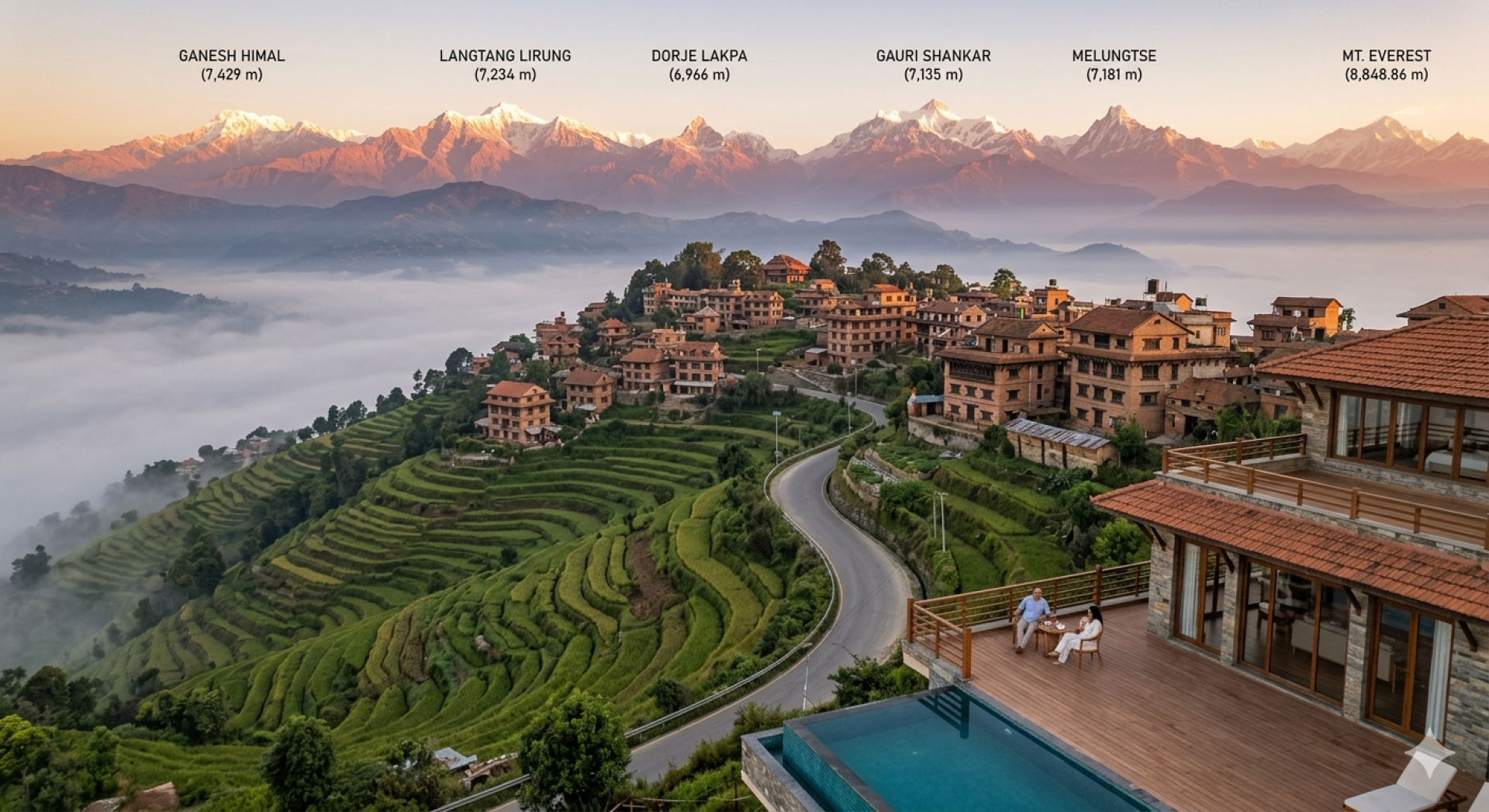
Let's start with the obvious: the view from Dhulikhel is extraordinary. On a clear morning, you can stand on your terrace and watch the sun rise over a 180-degree Himalayan arc that includes Ganesh Himal, Langtang, Jugal, Rolwaling, and the iconic Numbur range. This isn't a resort backdrop — it could be your everyday window.
For retirees and remote professionals, waking up to that view fundamentally changes the rhythm of a day. Research in environmental psychology consistently links natural mountain views with reduced stress hormones, improved mood, and greater overall life satisfaction. Dhulikhel doesn't just sell land — it sells a daily emotional reset.
Himalayan Panorama
Unobstructed views of over a dozen named peaks on clear days, year-round.
Clean Mountain Air
AQI levels dramatically lower than Kathmandu Valley — a significant health benefit for the elderly.
Moderate Climate
Cool summers (14–24°C) and mild winters make it liveable year-round with minimal AC or heavy heating.
Sunrise Rituals
Dhulikhel's eastern orientation makes it one of Nepal's finest sunrise-watching locations.
Strategic Location Without Isolation
One of the most compelling arguments for Dhulikhel as a second home or retirement destination is its position on the map. It sits approximately 30 kilometres east of Kathmandu along the Araniko Highway — close enough for a comfortable 45–60 minute drive to the capital's hospitals, airports, and commercial centres, yet far enough to feel worlds apart from urban chaos.
The Kathmandu–Banepa–Dhulikhel corridor has seen significant road improvement over the past decade. With the proposed outer ring road developments and improved highway widening, commute times are expected to decrease further. For families with working-age members in Kathmandu and retired parents seeking fresh air, Dhulikhel sits at the perfect intersection of accessibility and tranquillity.
Key Distances from Dhulikhel
| Destination | Distance | Approx. Drive Time |
|---|---|---|
| Kathmandu Ring Road | ~28 km | 45–60 min |
| Tribhuvan International Airport | ~35 km | 60–75 min |
| Banepa (nearest town) | ~8 km | 12–15 min |
| Namobuddha Monastery | ~10 km | 20 min |
| Panauti Heritage Town | ~14 km | 25 min |
Real Estate Value: Buy Before the Curve
Compared to Kathmandu Valley, land prices in Dhulikhel remain significantly more affordable — though this gap is narrowing rapidly. Over the past five years, property values in the Dhulikhel-Banepa area have appreciated by an estimated 30–45%, driven by growing demand from Kathmandu professionals, NRNs (Non-Resident Nepalis), and institutional developers constructing resort-style gated communities.
The current window of opportunity is real. Plots that could be acquired for NPR 8–15 lakh per aana three years ago are now commanding NPR 18–30 lakh in premium locations. Industry insiders note that once the proposed ring road extension fully materialises, Dhulikhel will experience a second wave of valuation increase that could mirror what happened to Bhaktapur's periphery in the 2010s.
Dhulikhel sits outside Kathmandu's built-up urban zone, meaning land acquisition formalities are often simpler, plots tend to be larger, and zoning for residential-commercial hybrid use is more flexible — making it ideal for self-built retirement villas or boutique homestay ventures.
Infrastructure That's Catching Up Fast
A common hesitation with hillside or semi-rural living is infrastructure quality — but Dhulikhel has been steadily bridging the gap. The municipality has invested heavily in road connectivity, water supply systems, and waste management over the past decade. Reliable electricity from the national grid, combined with growing solar adoption among newer residential projects, has effectively resolved the power instability that once characterised life outside the Valley.
Perhaps most significantly, fibre-optic internet connectivity has expanded substantially in Dhulikhel's main areas. For remote workers, digital nomads, and retirees who rely on video calls with family abroad, this is a non-negotiable, and Dhulikhel increasingly delivers it.
Infrastructure Checklist
- 24-hour electricity supply with solar backup options in newer developments
- Fibre broadband internet available in core urban zones (50–200 Mbps plans)
- Dhulikhel Hospital — a 450-bed teaching hospital with specialist services
- Regular bus and micro-van services to Kathmandu's Ratnapark and New Bus Park
- Kathmandu University campus providing a young, intellectual community
- Multiple schools including English-medium institutions
- Weekly fresh market and growing number of supermarkets in nearby Banepa
- Active municipality with digital service delivery portals
Healthcare: A Critical Factor for Retirees
For retirement living, healthcare proximity is arguably the most decisive factor. Dhulikhel scores unusually well here. Dhulikhel Hospital, affiliated with Kathmandu University, is a fully equipped tertiary-care institution operating within the town itself. It offers emergency services, specialist consultations in cardiology, orthopaedics, ophthalmology, and gynaecology, plus advanced diagnostics — all at costs substantially lower than Kathmandu's private hospitals.
For complex interventions or super-specialist care, the 60-minute drive to Kathmandu's major hospitals (TUTH, Grande, B&B, Norvic) remains practical. This dual-tier healthcare accessibility is genuinely rare for a hillside township and sets Dhulikhel apart from comparable destinations like Nagarkot or Kakani.
Having a 450-bed teaching hospital as your neighbourhood facility is something most Kathmandu residents can't claim. For retirees, this single factor can be the difference between peace of mind and chronic anxiety.
Community, Culture, and Quality of Life
Dhulikhel's old town retains a beautifully preserved Newari cultural identity — its courtyards, temples, and traditional architecture form a living heritage museum. But overlaid on this is a dynamic, educated young population thanks to Kathmandu University, giving the town a rare blend of deep-rooted tradition and forward-looking intellectual energy.
The community is welcoming to outsiders. Over the past decade, an influx of Kathmandu professionals building weekend homes has created an informal network of like-minded residents who appreciate both urban amenities and rural peace. Social clubs, trekking groups, and cultural events throughout the year ensure that isolation — a genuine concern for retirees — is far less prevalent here than in more remote retreats.
Lifestyle Amenities in and Around Dhulikhel
- Multiple resort hotels offering weekend dining, spa, and yoga facilities open to locals
- Namobuddha and Namo Buddha Monastery — significant spiritual sites within 10 km
- Panauti, a World Heritage candidate site, for heritage walks and cultural immersion
- Forest treks, bird-watching trails, and cycling routes through the Kavre hills
- Active expat and NRN community with growing social infrastructure
- Farmers' markets, organic produce networks, and farm-to-table dining options
Who Is Buying Property in Dhulikhel Today?
The buyer profile has diversified remarkably. Five years ago, Dhulikhel real estate was primarily driven by resort developers and weekend-retreat seekers. Today, the demand is coming from a much broader spectrum:
Remote Professionals
Tech workers and consultants escaping Kathmandu's pollution and cost while staying connected via fibre internet.
Returning Diaspora
NRNs from Australia, the US, UK, and Gulf countries building retirement or holiday homes in their homeland.
Active Retirees
Retired civil servants, military officers, and corporate professionals prioritising clean air, peace, and healthcare access.
Boutique Investors
Entrepreneurs building homestays, eco-lodges, and wellness retreats capitalising on Dhulikhel's growing tourist footprint.
Challenges to Consider Honestly
No destination is perfect, and honest assessment serves buyers better than marketing hyperbole. There are real considerations to weigh:
- Road congestion during festivals — the Araniko Highway can experience significant delays during major festivals, particularly Dashain and Tihar, when traffic to and from the eastern hills surges dramatically.
- Water supply variability — while improving, some areas still experience seasonal water pressure issues, making rainwater harvesting and storage infrastructure important for new builds.
- Limited entertainment options — Dhulikhel lacks the cinema halls, large shopping malls, and nightlife of Kathmandu. For urbanites with strong entertainment dependencies, this adjustment can be significant.
- Internet reliability in peripheral areas — fibre is concentrated in the core town; outlying plots may still rely on slower connections until infrastructure expands further.
- Construction costs — while land is cheaper, building quality homes on hillside terrain can attract premium construction costs due to access and foundation challenges.
These challenges are real but manageable — and in most cases, they are temporary constraints of a rapidly developing municipality rather than structural disadvantages. The trajectory is clearly upward, and early buyers absorb these friction points at significantly lower entry costs than those who wait.
Dhulikhel vs. Other Second-Home Destinations in Nepal
| Factor | Dhulikhel | Nagarkot | Kakani | Pokhara |
|---|---|---|---|---|
| Hospital Access | ✅ Excellent | Limited | Limited | Good |
| Internet Quality | ✅ Fibre Available | Moderate | Moderate | Good |
| Kathmandu Access | ✅ ~45 min | ~35 min | ~30 min | ~7 hrs / 25 min flight |
| Year-Round Livability | ✅ High | Moderate (cold winters) | Moderate | High |
| Cultural Heritage | ✅ Rich Newari | Low | Low | Good |
| Investment Appreciation | ✅ High Trajectory | Moderate | Low–Moderate | High |
Conclusion: The Window Is Open — For Now
Dhulikhel's rise as a premier second-home and retirement destination isn't accidental. It's the convergence of natural beauty, strategic location, improving infrastructure, serious healthcare, and a warm community — at a price point that still offers genuine value before the inevitable appreciation curve steepens further.
For Nepali professionals tired of valley pollution, for NRNs planning their return, for retirees who refuse to choose between comfort and clean air, and for investors who understand that the best opportunities live slightly ahead of the crowd — Dhulikhel isn't just worth a look.
It may be the smartest address decision you haven't made yet.
Thinking About Life Beyond the Valley?
Explore more guides on lifestyle, real estate, and tech trends for Nepal's emerging cities at DevelopersGuru.